The tipsy men, having cookies in their pockets, staggering, passed the alley.
Fereydoun Foroughi was one of the most prominent Iranian singers. His special musical style made him a unique singer before the 1979 revolution. A notable part of his work are protest songs like Yaare Dabestaani e Man (My Schoolmate), Khak (Earth) and Saal e Ghahti (Year of Famine). He was among the few artists who stayed in Iran after the revolution though he was banned from working for years.
I was a high school sophomore when a friend of mine sang to me part of the lyrics I brought above. At first it seemed like a funny song but when I listened to the full song I learned it was one the political songs that were made a few years before the 1979 revolution.
The lyrics are composed by Massoud Amini and the music by Manouchehr Chashmazar.
The Song
Year of Famine
The flowers in the vase have not bloomed. The trees have not fruited . The cattle has no milk to make dairy.
The wheats of the desert have not made a piece of bread. The springs of water have dried out.
I talked to everyone but heared no reply.
The tipsy men, having cookies in their pockets,
staggering, passed the alley.
Yo dead people!
Fear has taken your hearts!
Why are you so meek,
as if a beast has eaten your souls?
Stop being quiet!
Stop closing the doors of your houses!
Stop losing hope!
Have faith in someone!
Raise and fight with these terrible days.
What is the point if we are not even allowed to be smiling?
Hayedeh (born Ma'soumh Dadehbala) was Iranian diva of classical and pop music. She was the older sister of Mahasti the famous Iranian singer. Her professional career began in 1968. She sang traditionally at first but then during the 1970s she entered the world of pop music.
I suggest you read more about Hayedeh on Wikipedia.
The song I have translated here is one of her best tracks. I Love to Cry on Your Shoulders is something between classical and pop. It was written by Ardalan Sarfaraz and composed by Farid Zoland.
Lyrics
I put my head on your kind shoulders
the sorrow of my heart fades away as I burst into tears.
My heart is full of sorrow of inhumanity.
I love to cry on your shoulders.
I love to cry on your shoulders.
I love your absence as it makes me yearn for you.
With no selfishness, and with no earthly desires,
I love you beyond these natural desires. I love you more than I do myself.
I love to cry on your shoulders.
Love has so many hairdressers, your hand is one of them.
I love to see you [as a hairdresser] in the mirror.
In solitude I daydream about your love.
I love to see you fascinated by me.
I love to cry on your shoulders.
I love your absence as it makes me yearn for you.
I spent a lifetime in Chelle* hoping to see you.
I like to break the Chelle in the arrival of your love.
I am a wandering cloud ready to cry.
You are my mountain peak.
I love to cry on your shoulders.
With no selfishness, and with no earthly desires,
I love you beyond these natural desires. I love you more than I do myself.
* Chelle is a religious religious/mystic practice during which a person secludes himself from others and lives alone in a small room. He doesn't come out for forty days. The word Chelle comes from Chehel which means 'forty' in Persian.
Lyrics by Ardalan Sarfaraz
Translated by Mehdi Mehtari
Gallery
Ardalan Sarfaraz
Farid Zoland
Hayedeh
Monday, March 16, 2015
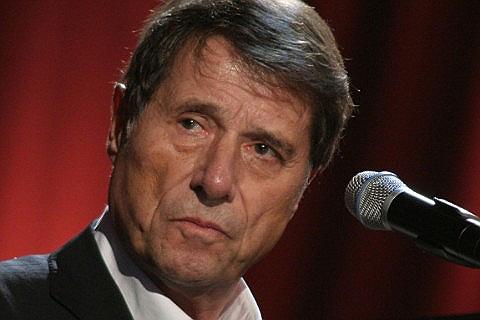
Udo Jürgens
Arguably one of the best Austrian musicians ever, Udo Jürgens (1934-2014) was active as a composer and singer for nearly sixty years. More than 100 million copies of his records have been sold. His style is regarded as a mixture of chanson, pop and Schlager. He was famous for not only writing entertaining songs but also giving them in a deep meaning; in many cases issues of the particular time. I've never been to New York (Ich war noch niemals in New York). The song critisizes philistinism and the way people are not following their dreams but keeping to absolutely senseless patterns. LYRICS
After lunch
he said,
darling,
let me go and get myself cigarettes,
she called “Take
the keys with you,
‘cause I’ll
look after our child in the meantime.”
He closed
the door, left without a word,
Into the well-lit
stairwell,
Which smelled
after polish and smugness,
And as he
was walking down the stairs it seemed to him as if this would be departure,
He could
just go away forever,
Forever.
I’ve never
been to New York, I’ve never been to Hawaii,
Never strolled
through San Francisco with torn jeans.
I’ve never
been to New York, I’ve never been free,
Why not be crazy
one time and escape all your constraints.
And as he
was out on the streets,
He realized
that he had everything with him,
His passport,
the credit card, a little bit of money,
Perhaps there’d
be a flight in the evening.
He could
call a cab or ask for a lift, simply get away somehow,
The desire
came up,
Be filled
with dreams one last time, escape the constraints,
He was
thinking about his escape, his escape….
I’ve never been to New York, I’ve never been to Hawaii,
Never strolled through San Francisco with torn jeans.
I’ve never been to New York, I’ve never been free,
Why not be crazy one time and escape all your constraints.
Then he put
the cigarettes into his pockets and went home like always,
Through the
stairwell with polish and smugness,
The wife
called “Darling, hurry up, “Wetten, dass….” starts in a second.”
She asked “Has
anything happened?” – “No, what should have happened?”
I’ve never been to New York, I’ve never been to Hawaii,
Never strolled through San Francisco with torn jeans.
I’ve never been to New York, I’ve never been free,
Why not be crazy one time and escape all your constraints.
Translation: Julian Trummer P.S.: "Wetten Dass..." was the most succesful German show series ever and although it can hardly be described as intelligent it became part of culture in some way.
Faegheh Atashin (born on 5 May 1950 in Tehran), also known by her stage name Googoosh (Persian: Guguš - گوگوش), is an Iranian singer and actress. She is known for her contributions to Iranian pop music, but also starred in a variety of movies from the 1950s to the 1970s.[1] She achieved the pinnacle of her fame and success towards the end of the 1970s. Her overall impact and contributions to Middle Eastern and Central Asian pop-music earned her the title of the most iconic female pop-singer from those regions. (Read more...)
Shahyar Ghanbari (born 28 July 1950 in Tehran) is an Iranian Poet, Writer, lyricist, songwriter, and singer of Persian pop music.He is also a Film director &Radio-TV Producer. Shahyar is the son of Hamid Ghanbari: Iranian actor, dubber and singer. He writes and sings in Persian, English and French. His songs typically feature Love, Solitude, and nostalgia. Mostly he writes his own lyrics, and composes for himself and for other singers. He Currently lives in U S A. (Read more...)
This song remarks the pains of Iranian migrants in Western countries. In it you hear of Venice, Rome, Paris, London and Los Angles (or as the poet calls it: the city with no angles)
Lyrics
I've traveled around the world.
I've been to the tired Taj Mahal.
I've been to the quite nights of the Shiva
with poetry as my dinner.
Nowhere could be as dear as my homeland,
no room could ever shelter me.
Venice was spectacular with all pirate ships.
A night in Rome with all bishops was a night of lonely springs.
The Madame Tussaud's was empty;
It was a place for chaffy faces.
The double checker red buses dancing in the fog
resembled a carpet being woven on a loom.
The morning in Champs-Elysee's was moonlit;
the Palace of Versailles was fully blue, like Dali's Sleep.
Paris was a sleepless city.
In front of me was the lady with a torch in her hand;
a little further, a black with no job was standing.
The City With No Angles was cold;
with loads of misery on blacks and Indians.
My pain was a nightmare to the painless.
I was next to me yet I felt lonely.
The night when the kites were lonely,
was the beginning and the end.
Lyrics by Shahyar Ghanbari
Translated by Mehdi Mehtari
Gallery
Googoosh
Shahyar Ghanbari
Monday, July 14, 2014
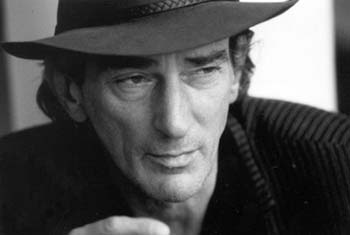
Hansi Lang
Hansi Lang
(1955-2008) was an Austrian musician and actor. He’s one of the few musicians
who adapted Rock to German language. Though not succesful throughout his
life, he is nonetheless admired as one of the finest Austrian musicians of
modern time well known for his live acts.
He
regularly played in the band of Austrian pop idol Falco. In his last years of
life he also played Blues and Jazz. In 2008 he died from the consequences of a
brain stroke, not unlikely to be a result of years of drug addiction.
Keine Angst
Released in 1980, Keine Angst (No fear) is his most notable success visualising the feelings of the generation of that time.
It's a song of those fellows in exile to those fellow countrymen in the motherland. Sad Easterner was first sung by Fereydoun Farrokhzad (R.I.P). The lyrics are composed by Iraj Jannati Ataaei. In it Jannati speaks of exile, homeland and the sun. He asks his fellow countrymen not to lose their hope and not to let "our sun" fade away. It's a song of hope and despair.
Why did I choosethis song? A couple of days ago I came to find a trailer of a documentary project to be made about Fereydoun Farrokhzad by DENKmal Film. On their tribute page to the artist, they asked everyone interested to sing this song and make a video clip of their singing and send it to DENKmal Film. Then on August 3rd they will release a mash-up video clip as a tribute to the artist. Plus they asked anyone who can translate the lyrics to any language they know. So I decided to translate them to English.
Yo Sad Easterner!
Yo Sad Easterner!
When the sun shone on you,
your scent filled the rain-soaked town,
and
the darkness got lost in your [dark] hair,
and the sun of freedom smiled
in your eyes.
Yo Sad Easterner!
You're like a mountain of light,
don't let our sun fade away.
You're as pure as the morning,
and as proud as the sea.
Don't let the darkness grow stronger. (chorus)
Yo Sad Easterner!
The sun rose once again,
and her dove flew away from your roof.
You're eyes are filled with the fragrance of spring.
The smell of cornflower reminds me of you.
Yo Sad Easterner!
It's painful to die in your absence.
It's painful to see there's no way out and grind my teeth.
It's impossible to plant the flower of loneliness in a swamp.
Yet there's no time to grieve.
Yo Sad Easterner!
Winter in before me!
When you're with me,
I have no fear of rain and mud.
The song of our clapping will be heared throughout winter.
There will be no fear of the winter because it will finish soon.
Yo Sad Easterner!
The west is nothing more than that.
In its blue eyes homesickness lies.
His masculine hands are as cold as ice in winters.
Come back to my embrace and we'll return home.
Lyrics by Iraj Jannati Ataaei
Translated by Mehdi Mehtari
Ludwig Hirsch (1946 - 2011) was an Austrian songwriter well-known for his morbid, dark songs. He had his biggest successes in the years around 1980, especially with his debut album Dunkelgraue Lieder (Dark Grey Songs). In 2011 he commited suicide.
Komm‘, großer schwarzer Vogel (Come, big black bird!)
This dark, melancholic song was his greatest success. It's about the longing for death.