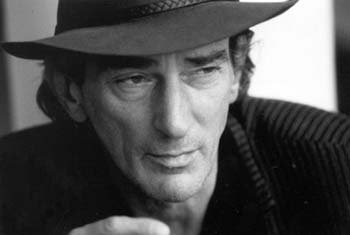
It's a song of those fellows in exile to those fellow countrymen in the motherland. Sad Easterner was first sung by Fereydoun Farrokhzad (R.I.P). The lyrics are composed by Iraj Jannati Ataaei. In it Jannati speaks of exile, homeland and the sun. He asks his fellow countrymen not to lose their hope and not to let "our sun" fade away. It's a song of hope and despair.
Why did I choosethis song? A couple of days ago I came to find a trailer of a documentary project to be made about Fereydoun Farrokhzad by DENKmal Film. On their tribute page to the artist, they asked everyone interested to sing this song and make a video clip of their singing and send it to DENKmal Film. Then on August 3rd they will release a mash-up video clip as a tribute to the artist. Plus they asked anyone who can translate the lyrics to any language they know. So I decided to translate them to English.
Yo Sad Easterner!
Yo Sad Easterner!
When the sun shone on you,
your scent filled the rain-soaked town,
and
the darkness got lost in your [dark] hair,
and the sun of freedom smiled
in your eyes.
Yo Sad Easterner!
You're like a mountain of light,
don't let our sun fade away.
You're as pure as the morning,
and as proud as the sea.
Don't let the darkness grow stronger. (chorus)
Yo Sad Easterner!
The sun rose once again,
and her dove flew away from your roof.
You're eyes are filled with the fragrance of spring.
The smell of cornflower reminds me of you.
Yo Sad Easterner!
It's painful to die in your absence.
It's painful to see there's no way out and grind my teeth.
It's impossible to plant the flower of loneliness in a swamp.
Yet there's no time to grieve.
Yo Sad Easterner!
Winter in before me!
When you're with me,
I have no fear of rain and mud.
The song of our clapping will be heared throughout winter.
There will be no fear of the winter because it will finish soon.
Yo Sad Easterner!
The west is nothing more than that.
In its blue eyes homesickness lies.
His masculine hands are as cold as ice in winters.
Come back to my embrace and we'll return home.
Lyrics by Iraj Jannati Ataaei
Translated by Mehdi Mehtari
Ludwig Hirsch (1946 - 2011) was an Austrian songwriter well-known for his morbid, dark songs. He had his biggest successes in the years around 1980, especially with his debut album Dunkelgraue Lieder (Dark Grey Songs). In 2011 he commited suicide.
Komm‘, großer schwarzer Vogel (Come, big black bird!)
This dark, melancholic song was his greatest success. It's about the longing for death.
A very humorous and sarcastic yet dark song is Omama (Grandma), very much in contrast to STS's Großvater (Grandfather).
Now we’re
standing here at the cemetery of Stammersdorf;
It’s
raining, my feet are already hurting.
The
priest says she was just such a good woman,
Nonetheless
I cannot really cry,
The grandma,
the grandma isn’t alive any more.
When I
was little, she pushed into my mouth the dumplings,
Waited for
me with the stick in the hand,
My
stomach was already turning sick,
She didn’t
care, she still gave me a hiding,
So long
till I already started praying:
“Dear
Jesus Christ, please let grandma conk out.”
The seven
raves, they were only six,
The good
fairy, she was a witch,
The bad
wolf, a little dachshund,
The fairy
tale prince, an awful git.
In
Stammersdorf she had her little flat,
With lace
doilies and a picture of Hitler,
A glass
of fat on the windowsill,
The
jerry under the bed,
Just so
white, fat, round and always full,
Perhaps we
should have put it in the grave as well!
One day I
asked her “Where’s grandfather?”
“Up in
heaven on a cloud he’s playing violin.”
For Führer,
Volk and Vaterland
He was
shot, hanged and burned,
But she
always forgave Adolf,
After all
he’d awarded her Mutterkreuz.
The seven
raves, they were only six,
The good
fairy, she was a witch,
The bad
wolf, a little dachshund,
The fairy
tale prince, an awful git.
In the
last time she was a bit weird,
The glass
of fat was under the bed,
The lace
dollies she burned,
Hitler
she called a criminal,
The jerry
she placed on the windowsill.
Everyone
in Stammersdorf was talking about her.
On
mother’s day we took her to the amusement park,
The old
lady was suddenly young again,
On the
Go-Cart she yodeled,
A few
langos she ate,
Just on
the white water ride there was a little misfortune,
There
she was suffocated by her artificial teeth.
The seven
raves, they were only six,
The good
fairy, she was a witch,
The bad
wolf, a little dachshund,
The fairy
tale prince, an awful git.
Goodbye,
grandma, do it better up there,
Don’t
cook dumplings for the angels, be so kind!
Don’t
annoy the saints, don’t denounce grandpa,
And if
you should visit god – a good tip:
Grandma,
don’t take the Mutterkreuz with you.
Translations: Julian Trummer
Wednesday, May 28, 2014
S.T.S.
With their biggest successes in the '80s, S.T.S. is one of the most successful Austrian bands. In their songs they combine traditional provincial Austrian music with pop on a high level; the lyrics are usually written in Styrian dialect, many songs are typically accompanied by their accoustic guitars.
One of their biggest successes is Großvater (Grandfather). It's a nostalgic song of a man remembering his grandfather who has been his role model throughout the whole life and wishing him back. His grandfather had taught him a lot for life, although he was nothing like outstanding or highly educated but just a modest, wise, decent man.
It may encourage us to recognize the hidden treasures within the ordinary people of our surroundings.
Lyrics:
Every
time there was quarrel with the mother
The
first thing I did was going to you
And you
said “She’s alone, you must understand her
Everything
passes by, c’mon let’s have a beer”
And then
you meant, the whole life is about taking
And a
lot more of giving,
So in the
next night out of the cupboard
I stole
the 1000 Schilling
For
spending in the discotheque
The day
after you asked me about it.
I denied
it, cried hysterically
Your
eyes were sad, then I wept
You just
said, “C’mon, forget about it
Money
can’t possibly be so important.”
When you
told me about the war
When you
looked with a Russian eye to eye
You both
offered each other a cigarette
The hand
on the trigger was shaking out of fear.
Or your
wife, who all day cried your ears full
You just
said “I love her
I don’t always
need to hear everything she says.”
Grandfather,
can’t you come down for a cup of coffee,
Grandfather,
there are just so many things to say I now came to understand,
Grandfather,
you were my first friend and that’s something I’ll never forget,
Grandfather.
You were
neither superhuman, nor pretended to be
Just
because of that there was some sort of power
But by
the way you lived your life
I recognized
how you may make it through
Your principle
was: Always think first
Have an
opinion you advocate
No violence, talk about everything
But never
be afraid of anyone.
Grandfather,
can’t you come down for a cup of coffee,
Grandfather,
there are just so many things to say I now came to understand,
Grandfather,
you were my first friend and that’s something I’ll never forget,
Grandfather.
Translation by Julian Trummer
Other notable songs:
Fürstenfeld. A slightly parodic song about the longing for getting back to province.
Irgendwann bleib I dann dort (One day I'll stay there). A song about going away from home forever.
One of thegreatest Iranian love songs in the history, Kiss Me (Persian: مرا ببوس) was first broadcast by Radio Iran amidst the struggles of nationalists with the Imperial regime.
The most famous version is sung by Hasan Golnaraghi on Heydar Reghabi lyrics.
The music was composed by Majid Vafadar.(Piano by Moshir Homayoun Shahrdar and Violin by Parviz Yahaghi)
However for the first time a rather obscure singer named Parvaneh sung it in a movie.
Other Iranian singers have also covered this song including:
This is the last time I say goodbye.
May God keep you safe.
I am going to look for my destiny.
Our good times passed.
I am going to look for my destiny.
Amidst the storm I'm allied with boatmen.
I might even have to sacrifice my life to survive the storm.
I have promised my loved-one to make fire in the mountains.
I start my journey a dark night, and go through gloomy roads.
My dear one! Don't let your tears fall over your skirt because of me!
My beautiful girl! I am your guest tonight; I stay with you until you put your lips on mine.
My beautiful girl! The flash of your eyes and your innocent tears brighten up my tonight!
I recently purchased this album by Tim Maia, the Brazilian Soul legend. Maia had a unique personality if nothing else. Many of his songs were composed while under the influence of LSD, and he spent his time in and out of prison. I can't explain Tim's life without expecting readers to dismiss him as a drug abuser and cultist, but I love his music anyway. That's why I've let this video biography do the explaining for me, and embedded the album entitled The Existential Soul of Tim Maia: Nobody Can Live Forever. Enjoy!
Saghf (Persian: سقف)(Literary: Roof) is one of the most beautiful Iranian songs. It was first performed by Farhad Mehrad in the 1970s. The lyrics are composed by Iraj Jannati Ataei , one of the dominant literary figures of contemporary Persian literature.
Here I have translated the lyrics to English:
I'm thinking of a shelter
I'm thinking of a shelter,
a shelter with no holes on its roof,
a sturdy one, harder than iron.
A shelter to cover our fears,
and to make us warm at cold nights.
A shelter as big as our hearts,
to touch the beating of anxiety,
to feel the delicate shame of moments,
and to be filled with the smell of Petunia.
Under this shelter I speak to you of flowers, the night, and stars.
Of you and pleading you, I speak over and over.
I compare my life to yours under this shelter; I get lost in the deepness of your meaning to get new meanings.
But alas!
This shelter is nothing but a cloudy sky and the shortest distance between us is as long as the horizon.
I'm thinking of a shelter, a dream shelter,
a shelter for us, even if it is made of cardboard.
I'm thinking of a shelter, one with no holes on its roof,
a shelter for love, for you and I.
Under this shelter, if we ever have it,
your heart will make us warm,
your hand will cover its holes.
Under this shelter, it's good for us to perfume the scent of self-forgetting,
to sleep with a story, to wake up with a song.
I'm thinking of a shelter...
Some of the most smooth music I have ever heard is Congolese Rumba music. Le Grand Kalle formed in Belgian-occupied Congo in the 1950s, and eventually became popular in and outside of Africa. Many of their songs supported the Congolese independence movement, as well as the Pan-African movement. This style of music had heavy influences on music from Cuba and other parts of Latin America.